MentalHealthCE Login


| Login | ||

Healthcare Training Institute - Quality Education since 1979
CE for Psychologist, Social Worker, Counselor, & MFT!!

Section 17
Sexual
Abuse Analysis of Drawings:
The Projections of Ego Functions
Question 17 | Test | Table of Contents
The remainder of this chapter is devoted to looking at how these
breakdowns in youngsters' ego strengths are manifested through abused children's
projective drawings. In analyzing the House, 'free, Person, and Kinetic Family
Drawings created by misused children within six months of their abuse, images
of the ego damage they have sustained will be graphically portrayed. While there
may be other interesting and noteworthy aspects in each of the renderings, for
the purpose of this chapter, we will focus exclusively on those items that reflect
disturbances and strengths in ego structure.
Carole
This first drawing, Plate B, depicts ego dysfunction and was penciled by 8-year-old
Carole. She was violated by her father by being forced to view pornographic videos
while lying In bed at his side. It is not clear how many times this occurred nor
for how long. Soon after the last of these events, her parents separated, and
in the process, her mother became extremely depressed and incapable of functioning.
Carole tried to care for her mother and assumed full responsibility for her 4-year-old
brother, Evan. These circumstances blended together and led to the Impairment
of her ego.
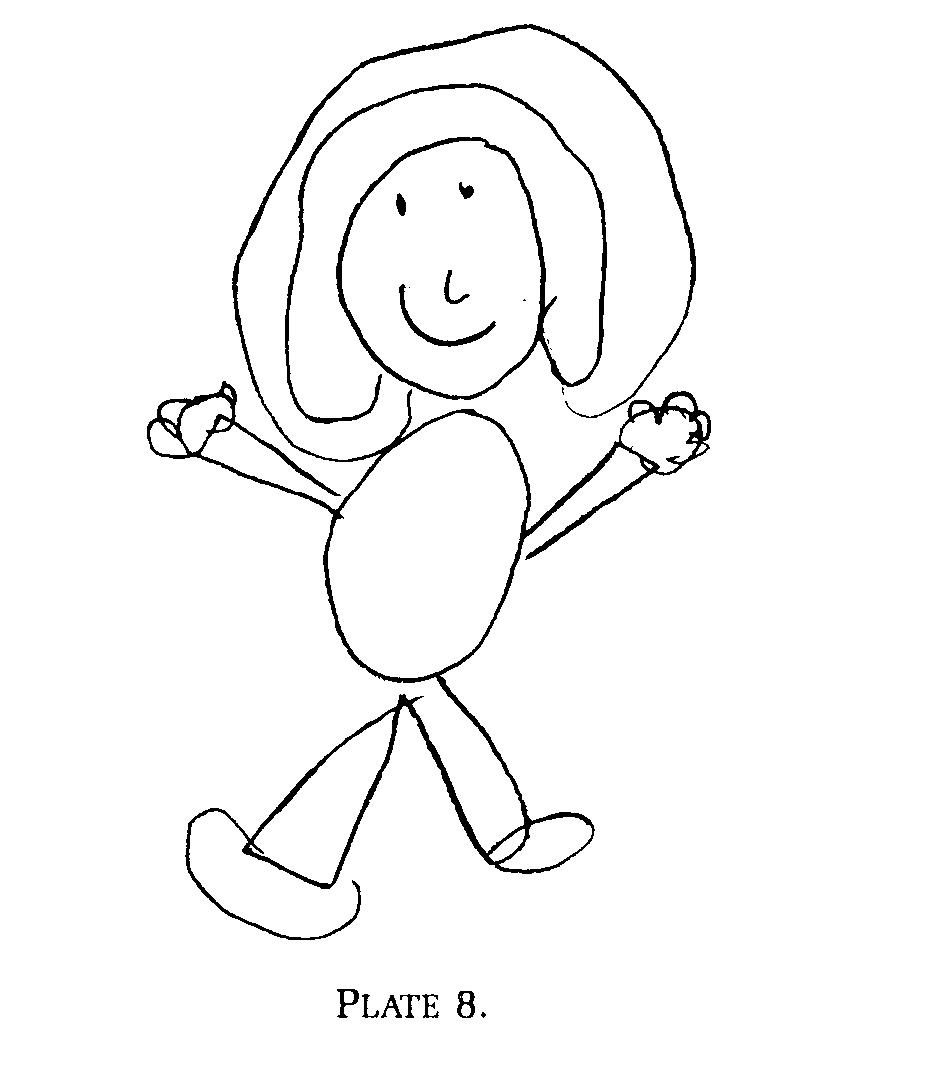
The most striking feature of Carole's drawing is her treatment of the head, the body part most commonly associated with the ego (Machover, 1980; Ogdon, 1977). Generally speaking, we expect to see exaggerated head sizes in the drawings of 4-year-olds. By the time a youngster reaches Carole's age, she or he is more reality-based. As such, a head as large as the torso is considered unusual (Hammer, 1980). When we couple the enlarged head with the reinforced hairline, we see a picture of a child who is struggling to contain her impulses through ego defenses. The break between the head and body (the head is not attached to the body) may graphically represent Carole's deployment of the defense mechanism of isolation. Isolation is a means through which an individual copes by separating ideas from the feelings with which they were initially connected. Carole's use of this particular defense alerts us to the possible process of emotional numbing, which is one of the ways that many sex abuse victims cope with feelings and anxiety too overwhelming to otherwise handle. A major consequence of the habitual use of this defense may be the development of alexithymia.
Ralph
Plate 11 represents the second phallic body produced by a child asked to draw
a picture of a person. This one, drawn by 5-year-old Ralph, is brimming with indications
of sexuality gone amuck. Ralph is an identical twin who was physically and sexually
abused by his father and his father's girlfriend. The molestation consisted of
exposure to pornographic movies, objects forced into his anus, and needles inserted
into his toes and penis. The physical violations were confirmed through medical
examination. In addition, his father and aunt took pictures of him naked in his
bedroom. Ralph revealed that his father threateningly showed him a brown egg and
warned that if he or his brother told anyone what they were doing, he would crack
the egg and kill the chick growing within it.

A second striking feature is the thin and elongated neck which is associated with feelings of body weakness and organ inferiority "with a compensatory drive or reaction formation towards physical power or aggression tendencies" (Ogdon, 1977, p. 79). This type of neck also connotes Ralph's attempt to separate his thoughts from his emotions, since these feelings contribute to his problems controlling his impulses. The tiny head in relation to the huge phallic body, however, tells us that his impulses are winning the battle for control and overrunning his ability to use his intellect.
Roger
Roger, Ralph's identical twin, was the unfortunate recipient of the same abuse
foisted upon his brother. What is particularly noteworthy, however, is the different
reactions each child had to the trauma. Both boys were treated at a local child
guidance clinic once the abuse was revealed. While Ralph easily recounted the
events that took place with his aunt and father, Roger sat silently by his side
and shrugged his shoulders sadly when asked if he recalled the same events. Roger
neither disputed nor acknowledged his brother's statements. He appeared overcome
with shame, inhibiting his capacity to elaborate on his feelings or thoughts.
Although these twins look exactly alike, their internal world is markedly divergent.
This is revealed by both their behavior and their drawings.
Ralph presents a menacing figure whose impulses have gone wild and whose controls are strained to their limits. Roger, on the other hand, drew two figures (Plate 12 and Plate 13) whose robotlike quality shows successful restraint. Roger struggles to control, or box in, his feelings and Impulses. Although he is effective in keeping his Impulses at bay, the cost is his disconnection from his feelings- emotional numbness. He Is not only alienated from himself but, as important for a latency-age child, keeps himself distant from others. The single, second-floor window in Plate 14 projects his withdrawal from the world (Jolles, 1964). No one is tall enough to look within; he is therefore able to remain aloof.

Remarkable to Roger's drawings is the tenuous connection between the crown and the tree trunk. While it is normal for a 5-year-old to draw a line separating the crown from the trunk (Koch, 1952), the space created by Roger emphasizes a division. It graphically portrays the foliage's disconnection from the nourishing juices of the trunk. The trunk is an accepted representation of the ego (Buck, 1981). The gap between the two tree parts may, therefore, mirror Roger's inability to self-care, an important ego function. This may also explain the description Roger gives In the PD! that the circles or fruits on the crown are oranges. Like the oranges, he has developed a thick skin to protect his fragile interior. Similarly, the boxy torsos (Plates 12 and 13) shield the vulnerable self from the world. These squared-off bodies represent Roger's attempt to hold things In, in order to keep himself together, not fall apart, and not act on his impulses.
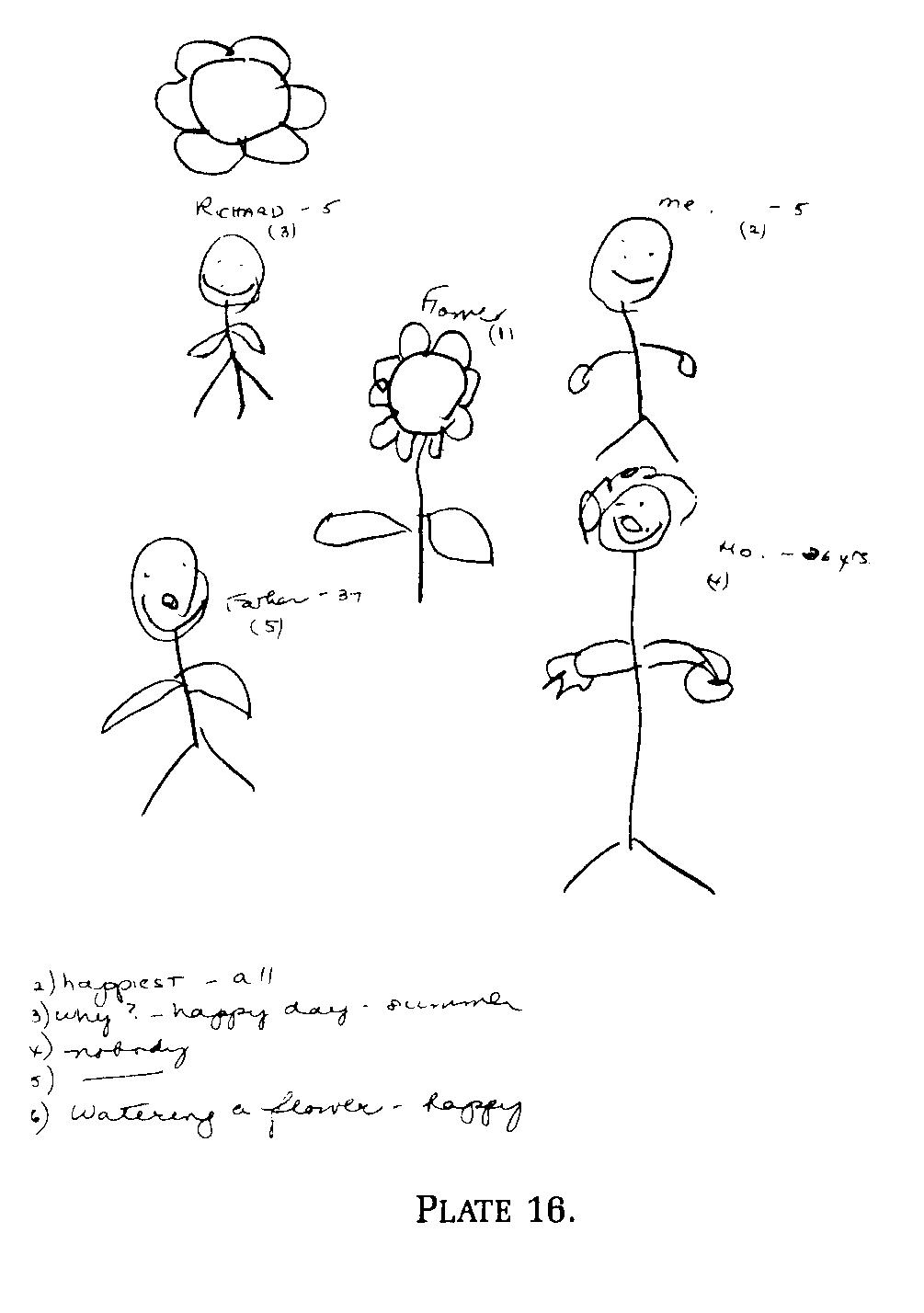
Yet, the other parts of the figures belie these joyful expressions. Particularly, in the KFD, the family members look much like unrooted flowers waiting to be plucked. Roger's distress is further echoed In the HFDs, where we note the short, flimsily connected arms. Machover (1980) states that arms and hands refer to "ego development and social adaptation. It is with arms and hands that we feed, dress, perform skills, explore our body and contact persons about us. It is with arms that we love and caress, hurt and kill, disrupt and adapt" (p. 80). Roger's treatment of arms in his drawings depicts his difficulty in ego development and socialization. However, we also notice that, despite their weakness, the arms extend outward Into the environment representing his desire for contact. Sadly, however, his ability to achieve this is impaired. This helplessness is further confirmation of the message conveyed by the encapsulated branch structure In Plate 15.
A final noteworthy point is the reflection of Roger's anxiety.
A huge cloud runs the width of the drawing in Plate 14, looming above the house.
Beneath it floats a smaller but menacing one. Clouds represent the artist's anxiety
(Hammer, 1954). As such we see that despite Roger's efforts to deny and defend
against his feelings, anxiety breaks out and shadows his home environment.
- Kaufman, Bobbie, & Agnes Wohl, Casualties of Childhood: A Developmental
Perspective on Sexual Abuse Using Projective Drawings, Brunner-Routledge: New
York, 1992.
Personal
Reflection Exercise #3
The preceding section contained information
about the projections of ego functions in the drawings of sexually abused children.
Write three case study examples regarding how you might use the content of this
section in your practice.
Update
Children’s Drawings as a Projective Tool
to Explore andPrevent Experiences
of Mistreatment and/or Sexual Abuse
Ballus, E., Comelles, M., Pasto, M., Benedico, P. (2023). Children’s drawings as a projective tool to explore and prevent experiences of mistreatment and/or sexual abuse. Frontiers in Psychology, 14(1), 1664-1078. https://www.frontiersin.org/articles/10.3389/fpsyg.2023.1002864
Peer-Reviewed Journal Article References:
Ensink, K., Borelli, J. L., Normandin, L., Target, M., & Fonagy, P. (2020). Childhood sexual abuse and attachment insecurity: Associations with child psychological difficulties. American Journal of Orthopsychiatry, 90(1), 115–124.
Jones, T. M., Bottoms, B. L., & Stevenson, M. C. (2020). Child victim empathy mediates the influence of jurors’ sexual abuse experiences on child sexual abuse case judgments: Meta-analyses. Psychology, Public Policy, and Law. Advance online publication.
Schuler, M., Mohnke, S., Amelung, T., Dziobek, I., Lemme, B., Borchardt, V., Gerwinn, H., Kärgel, C., Kneer, J., Massau, C., Pohl, A., Tenbergen, G., Weiß, S., Wittfoth, M., Waller, L., Beier, K. M., Walter, M., Ponseti, J., Schiffer, B., . . . Walter, H. (2019). Empathy in pedophilia and sexual offending against children: A multifaceted approach. Journal of Abnormal Psychology, 128(5), 453–464.
QUESTION
17
The break between the head and the body (the head is not attached to
the body) according to Kaufman may graphically represent development of what defense
mechanism? To select and enter your answer go to Test.